Ugochukwu Uzuegbu
Not a Liberal Cause: The Politicisation of Climate Action
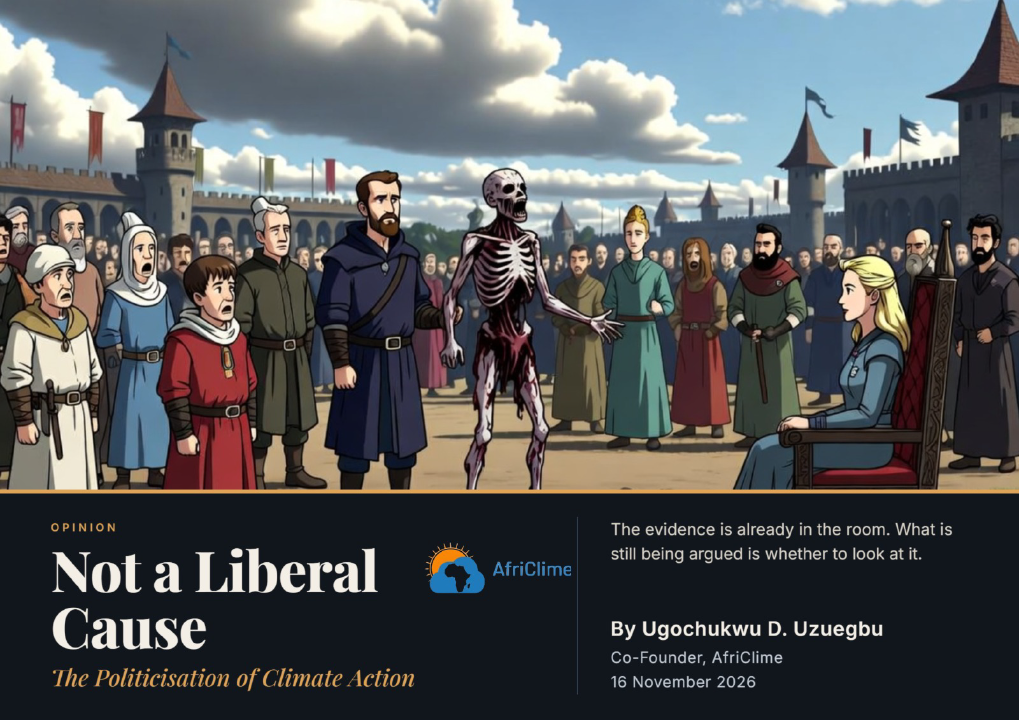
There is a telling moment in Game of Thrones when emissaries from across Westeros gathered before Cersei Lannister, urging her to set aside rivalries and join a common fight against the White Walkers. They do not come with rumors, but with proof: an animated corpse from beyond the Wall as undeniable proof that an existential threat is real and advancing. She sees the moving dead man with her own eyes, understands the threat, and yet faced with evidence of a common threat, she ultimately chooses political advantage over collective security.
This scene is uncomfortably too familiar because it relates to an underlying problem with identity politics where faced with evidence that should make every other consideration secondary, the instinct for political survival prevails.
Today, Armed with overwhelming scientific evidence that climate change is real, accelerating, and dangerous, too many leaders and actors, like Cersei, still treat it as a negotiable issue, filtering their responses through ideological loyalties and partisan divides. Just like the animated corpse, the evidence is all around us: devastating floods that swallow communities and destroy livelihoods, prolonged droughts and crop losses threatening food security, and extreme heat putting lives, public health and economic productivity at risk. The consequences are no longer distant projections of what might happen. They are increasingly part of the lived reality of millions of people across the world, and do not recognise political boundaries, ideological differences or national interests. Its impacts in one part of the world can reverberate across others, reminding us that the consequences of inaction are not confined to the countries or communities that contribute most to the problem. As United Nations Secretary-General António Guterres stated in his remarks at COP31, “No country can protect itself from climate change alone. We share one planet, and whether we like it or not, we share one fate.”
That is precisely what makes the politicisation of climate action so dangerous: when political identity makes acknowledging the problem seem inconvenient. Undeniably, countries have different economic realities, development needs, energy requirements and capacities, and these differences deserve serious consideration. We need to ensure that such disagreements do not become excuses for denying or deliberately obscuring the underlying problem. We do not need identical policies. What we need is a shared acceptance of the climate reality, so that honest arguments about the best pathways on fairness and transition can happen without pretending the underlying science is in question.
Noteworthy is that climate action has not always belonged to one political persuasion. The United Kingdom’s Climate Change Act of 2008 was passed under a Labour government with broad cross-party support, backed by consecutive Conservative governments and tightened by Prime Minister Theresa May in 2019 to make net zero by 2050 legally binding. That consensus has since frayed. The Conservatives under Kemi Badenoch have pledged to scrap the Act if they return to government. The UK shows both what cross-party cooperation can achieve and how fragile it is. At the same time, climate advocacy can become counterproductive when it is presented as inseparable from wider ideological positions or appears indifferent to the costs of transition, jobs, household incomes and access to reliable energy. These concerns deserve to inform how climate policies are designed and communicated, not become reasons to reject the scientific evidence.
Furthermore, the consequences of this politicization extend beyond rhetoric and public perception. They are increasingly visible in the difficulty of negotiating, agreeing on and implementing the solutions the world needs. The international climate process of the United Nations Framework Convention on Climate Change (UNFCCC) offers perhaps the clearest illustration.
The UNFCCC process, which culminated in the adoption of the Paris Agreement in 2015, was a remarkable feat of multilateral diplomacy. For the first time, countries came together under a common framework to pursue a shared temperature goal. But reaching an agreement was never the same as solving the problem. The agreement depends on countries turning commitments into national policy, strengthening their ambition over time and supporting one another’s efforts. It is precisely at this stage that the politicisation of climate action becomes particularly consequential.
More than a decade later, the gap remains substantial. UNEP’s Emissions Gap Report 2025 found that even full implementation of countries’ latest pledges points to roughly 2.3–2.5°C of warming this century, and that most countries are not on track to meet even their 2030 targets.
Since then, almost every successive climate conference arrives with renewed declarations about moving from promises to implementation. Yet, the same fundamental disagreements have continued to constrain progress. This challenge is not confined to the multilateral negotiating rooms of the UNFCCC. Bilateral climate cooperation has equally suffered as a result of the shifting tides of international politics. Partnerships that should provide opportunities for countries to exchange technology, mobilise finance, develop clean energy infrastructure and strengthen climate resilience can become entangled in broader diplomatic tensions and competing strategic interests.
The politicisation of climate action does more than complicate international negotiations; it erodes the political will to act. When the science itself becomes part of an ideological contest, those raising the alarm are increasingly discredited and dismissed as woke activists or alarmists, rather than engaged with on the strength of the evidence they present. Discrediting the messenger does not invalidate the message, but it does make sustained commitment much harder to maintain. Climate action becomes vulnerable to electoral cycles, ideological shifts and the political fortunes of individual leaders.
Perhaps no example illustrates this better than the United States under President Donald Trump. During his first presidency, President Trump announced the country’s withdrawal from the Paris Agreement in 2017, a decision that took effect in 2020 before the Biden administration rejoined the agreement in 2021. On returning to office in January 2025, he moved to withdraw the United States from the agreement once again.
His administration would go further to issue executive orders reversing several climate policies, roll back environmental regulations, promote expanded fossil fuel production, revoke international climate finance commitments and dismantle federal initiatives supporting climate action. In January 2026, the administration went further still, directing the withdrawal of the United States from the UNFCCC itself. It also announced the country’s withdrawal from the Green Climate Fund. These are not merely changes in domestic policy; they represent a retreat by one of the world’s largest economies and historically largest greenhouse gas emitters from the international cooperation required to address a global problem.
The political implications are not confined to the United States. Similar ideological positioning has shaped environmental policy and international climate engagement elsewhere.
In Brazil, former President Jair Bolsonaro pursued an agenda that weakened environmental protection, questioning climate science, and presiding over a period of intensified destruction of the Amazon rainforest. His administration undercut the capacity of environmental agencies responsible for monitoring deforestation and enforcing environmental laws. Data from Brazil’s National Institute for Space Research (INPE) show that annual deforestation in the Legal Amazon increased from 7,536 square kilometres in 2018 to 11,594 square kilometres in 2022, an increase of approximately 54 per cent during the period spanning his presidency. His administration also withdrew Brazil’s offer to host COP25 in 2019.
In Argentina, President Javier Milei’s administration recalled its delegation from COP29 in Baku in November 2024, only days after the negotiations began. The decision was accompanied by a review of Argentina’s position on international climate commitments, including the possibility of withdrawing from the Paris Agreement. Although the government ultimately did not proceed with withdrawal.
These developments reflect a wider tendency among some political leaders to frame climate action and international environmental cooperation as ideological or economic impositions rather than responses to a shared global threat.
The danger is that when influential political leaders treat climate action as an ideological project to be resisted, they provide legitimacy to similar positions elsewhere. The result is a weakening of the political consensus on which international cooperation depends. Agreements painstakingly negotiated over years become vulnerable to the changing preferences of individual administrations, while the urgency of the problem is lost in partisan contests.
There is, therefore, a need to depoliticise climate action. This does not mean the absence of debate. Decisions about energy, jobs, public spending, industrial development and the distribution of transition costs are inherently political, and they should remain open to legitimate democratic debate. Rather, it means refusing to make the scientific reality of climate change a partisan test. We can disagree about the solutions, the pace of transition and who should bear the costs without disagreeing about the existence of the problem.
Clean air, reliable energy, protection from floods and food on the table are not liberal or conservative values. They are human needs. The climate crisis does not change with the political fortunes of its deniers, and it does not care about ours either.