Ugochukwu Uzuegbu
THE STORY OF A VANISHING LAKE
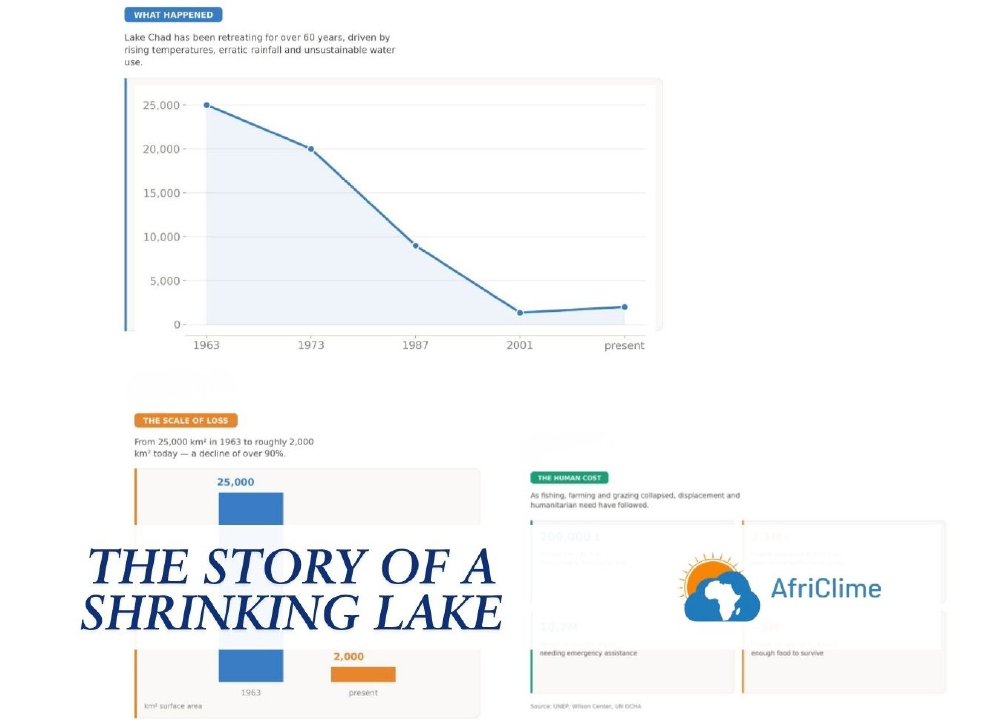
A lake does not disappear overnight. It shrinks gradually—year by year, season by season—until the changes become impossible to ignore. For the communities that depend on it, a changing lake is more than an environmental story: it can mean lost livelihoods, disrupted ecosystems, water insecurity and a changing way of life.
Lake Chad tells this story vividly. From a vast lake spanning about 25,000 km² in the 1960s, it shrank by roughly 90% by the 1990s, one of the world’s most dramatic lake transformations. It has stayed near that smaller size since, occasionally fluctuating with the seasons, but never returning to what it once was.
What happened to this lake, and what does it tell us about the changing climate?
A Lifeline for Four Nations:
Lake Chad sits at the intersection of Chad, Nigeria, Niger, and Cameroon, making it one of the few resources in the region shared across borders. Around 30–50 million people across the basin depend on it for drinking water, fishing, farming, and grazing land for livestock. For generations, the rhythm of life here was set by the lake’s waters.
Why it Shrank and Why it Hasn’t Fully Recovered:
The lake’s dramatic decline in the 1970s and 1980s was driven largely by severe, prolonged drought across the Sahel, compounded by rising temperatures and increasing demand for irrigation from the rivers that feed the lake.
Rainfall partially recovered from the 1990s onward, and Lake Chad has been relatively stable in recent decades. But stable does not mean secure. Rainfall across the basin remains highly variable and increasingly unpredictable, adding to the pressures on water, agriculture and livelihoods.
What the Disruption Has Cost:
The consequences have extended far beyond the shoreline. Fishing communities that once harvested around 200,000 tonnes of fish annually have seen catches fall dramatically. Erratic rainfall has undermined traditional farming practices, while competition over land, water and other resources has contributed to conflict, insecurity and displacement.
Today, an estimated 10.7 million people across the region require humanitarian assistance, while nearly 5 million face food insecurity.
Fighting Back—Restoration Efforts Underway:
Governments and international partners are working to rebuild the basin’s resilience. The Great Green Wall, an 11-country initiative to restore Africa’s drylands, aims to restore 100 million hectares of land and create 10 million green jobs by 2030, with restoration efforts underway in Chad and across the Sahel.
The World Bank-backed PROLAC project, with $170 million in financing, is supporting climate-resilient agriculture, livelihoods and regional cooperation across the Lake Chad Basin. In 2025, the African Development Bank and the Lake Chad Basin Commission also signed a $10.2 million grant to support efforts to study and advance the ecological and economic revitalisation of the lake.
A Regional Crisis, a Global Signal:
The story of Lake Chad is therefore not only about a shrinking lake, but also about water, livelihoods, resilience and who bears the cost of a changing climate.